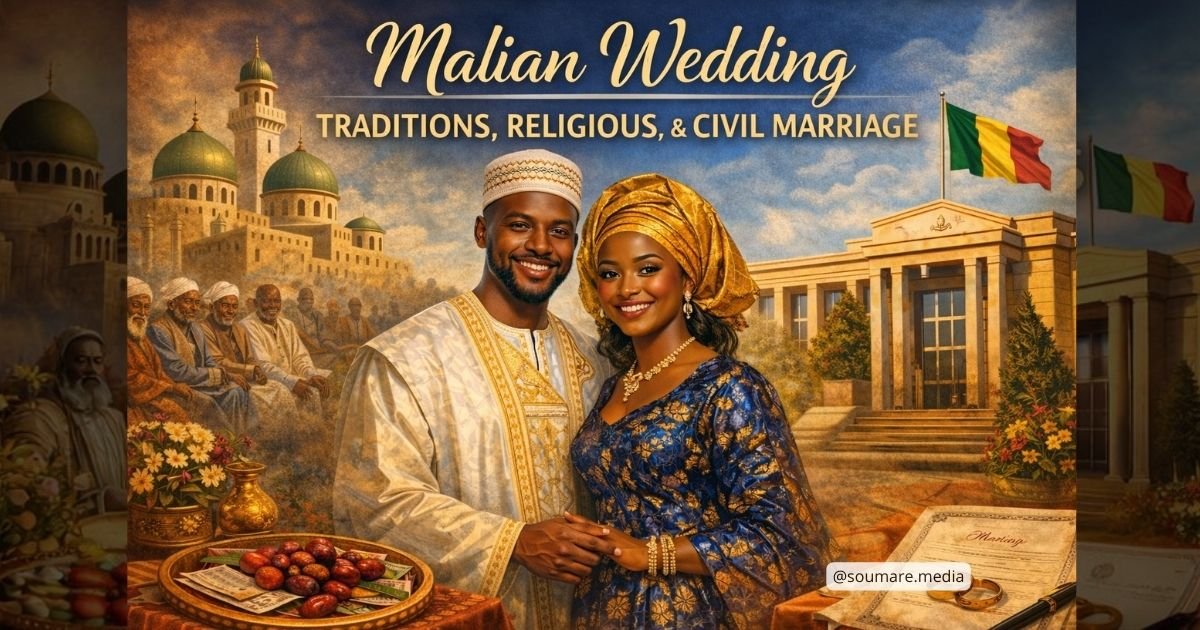
Discover the three key stages of a Malian wedding: the traditional, religious, and civil ceremonies. Blending cultural customs, spirituality, and legal structure, this institution reflects a rich and meaningful heritage.
A Malian wedding is built on three essential stages: traditional, religious, and civil.
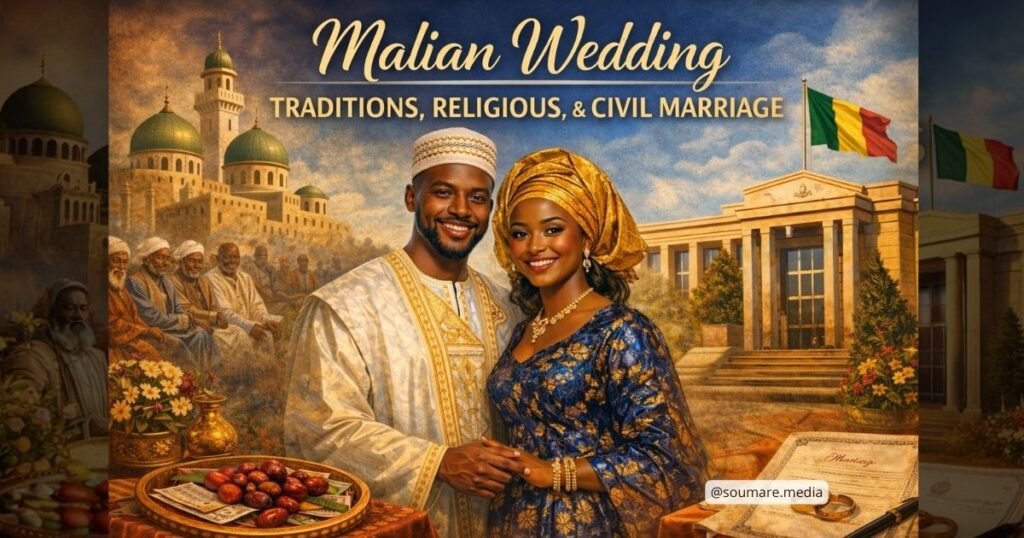
🧭 Traditional Marriage in Mali: The Union of Families
In Mali, marriage is not simply the union of two individuals.
👉 It is, above all, the union of two kabilas — families, lineages, and sometimes entire communities, each carrying its own values, history, and responsibilities.
Within this framework, marriage becomes a structured process where each stage serves a distinct purpose:
- social (traditional)
- spiritual (religious)
- legal (civil)
Getting married therefore means entering a collective system of commitment, where nothing is left to chance.
🥁 1. Traditional Malian Marriage: The Foundation of the Union
🧩 A Structured Alliance Between Families
Traditional marriage forms the foundation of the entire union.
👉 Social validation:
Before the couple is fully involved, both families meet, exchange, and evaluate the compatibility of their respective kabilas, especially in terms of values, upbringing, and social standing.
👉 A community-centered approach:
Each family brings more than an individual — it brings a history, a reputation, and a set of values it seeks to uphold.
🧔🏾 The Balimake-Kuntigi: A Key Figure on the Groom’s Side
The balimake-kuntigi plays a central role in organizing the marriage process.
👉 Leading the marriage proposal process:
He initiates contact between the families, often through a griot (djeli), who conveys messages and facilitates communication according to tradition.
👉 Managing symbolic commitments:
He oversees the payment of kola nuts, a fundamental gesture marking the official beginning of the marriage process and demonstrating the seriousness of the commitment.
👉 Coordinating religious arrangements:
He liaises with the mosque, helps prepare the religious ceremony, and ensures that related expenses are handled.
👉 Handling administrative coordination:
He may gather required documents, assist with pre-registration at the local authority, and follow up on obtaining the marriage certificate.
👉 Representing the groom’s family:
Through his conduct, he reflects the image and credibility of the groom’s family, influencing the relationship between both sides.
👩🏾 The Balimamuso-Kuntigi: Organization and Cultural Transmission
The balimamuso-kuntigi plays a key role in the female dimension of the marriage.
👉 Coordinating the trousseau:
She oversees the preparation of the bride’s trousseau (wedding luggage), organizes contributions from women in the family, and ensures quality and consistency.
👉 Passing down knowledge:
She facilitates discussions where women share advice on married life, household management, and social expectations.
👉 Supporting integration:
She helps the bride transition into her new family and fosters a climate of trust and reassurance.
👉 Maintaining relational balance:
She brings warmth and emotional intelligence to complement the more formal role of the balimake-kuntigi.
💰 The Dowry: Commitment, Respect and Modern Challenges
The dowry remains a central element of traditional marriage.
👉 The groom’s commitment:
It demonstrates his ability to take responsibility, provide for his spouse, and build a stable household.
👉 Respect for the bride’s family:
It acknowledges the parents’ role in raising and educating their daughter.
👉 Social validation of the union:
It formalizes the marriage within the community.
👉 A modern tension:
Although symbolically regulated (around 15,000 FCFA), expectations today can exceed this amount, creating financial pressure.
🎁 The Trousseau: Preparing for Married Life
👉 Practical preparation:
The bride’s luggage contains essential items to help her settle into her new home.
👉 Transmission of women’s knowledge:
Women share practical advice on relationships, household management, and social conduct.
👉 Cultural framing:
This moment reinforces family values and expectations.
👉 Emotional support:
The bride is surrounded, reassured, and psychologically prepared for this life transition.
🕌 2. Religious Marriage in Mali: Spiritual Legitimacy
The religious ceremony is the heart of the union.
👉 Validation before God:
It involves mutual consent, witnesses, and prayers that legitimize the marriage spiritually.
👉 A moment of collective blessings:
Family members offer prayers for stability, peace, and success in married life.
👉 Strong emotional intensity:
This is often the most meaningful moment, combining spirituality, tradition, and deep emotion.
👉 Connection to administrative steps:
Documents prepared during this stage may be used for civil registration.
🏛️ 3. Civil Marriage in Mali: Legal Recognition
Civil marriage is the final step of the process.
👉 Protection of spouses’ rights:
It legally defines the relationship and ensures rights in case of disputes or separation.
👉 Securing inheritance:
It clarifies succession rights and helps prevent family conflicts.
👉 Recognition of children:
It provides a clear legal framework for filiation and child protection.
👉 Administrative validity:
It facilitates official procedures, especially in cases of mobility or diaspora.
👉 Adaptation to modern realities:
Through legal mechanisms such as proxy, marriage can be conducted even if one partner is absent.
🔗 A Balance Between Three Pillars
Malian marriage is built on a structured balance:
- Traditional: social validation
- Religious: spiritual legitimacy
- Civil: legal protection
👉 Each stage complements the others and strengthens the union.
❤️ Conclusion: A Living and Evolving Institution
A Malian wedding is far more than a ceremony.
It embodies:
- the strength of family ties
- the transmission of values
- the central role of faith
- and adaptation to modern realities
👉 It is a journey — a gradual construction where every participant plays a role.
And at its core, one truth remains:
👉 Marriage is not just about uniting two individuals, but about connecting histories, values, and generations.
Lire la version française : 🔗 https://soumare.media/mariage-malien-tradition-religieux-civil/
Top News
 Malian artist Prince Diallo reportedly targeted in Bamako shooting
 Mali: Music Maestro Boncana Maïga Dies at the Age of 77
 Esco P – Inouss Koné (New Malian Music 2026)
 Bezy One Feat. Babani Diabaté – Fatoucis (New Malian Music Collaboration)
 DR KEB – Woza 2 (New Malian Rap 2026)
 Tiguida Kanté: A Rising Voice of Contemporary Malian Music
 Karamoko Sinayoko Speaks on OM TV About His Bozo Roots and Personal Journey
 Tiguida Kanté Recalls the Day Her Mother Passed Away in “Tribute to Mother – Part 2”
 Fatô Diamatigui: the Malian rapper formerly known as Adji-One Centhiago
 Tiguida Kanté releases “Amina Fashion” – Official music video unveiled
 Souleymane Keita “Kanté” honored as Knight of the Order of Arts and Culture
 Sidiki Diabaté: Biography of a Leading Figure in Contemporary Malian Music